DJI
Most expandable Image © DJI
Power 2000 + Expansion Battery 2000
- Capacity
- 4,096 Wh
- Output
- 3,000 W
- Battery
- LFP
- Extra batteries
- Up to 22,528 Wh
Best verified UK price£1,758DJI Store UK · checked 13 Nov 2026. Inc. VAT.


BACKUP POWER
Evidence-led
Prices checked on UK retailers’ own product pages, 13 Nov 2026. Specs from the manufacturers.
Practical
Real examples of what each size will run, and for how long.
Independent
We show where sources disagree. Buying through our links costs you nothing extra.
Battery size is measured in watt-hours (Wh): the bigger the number, the longer it runs. Start with what you want to keep going, then pick a size.
Home backup
4,000 Wh and up
Fridge-freezer, router, lights and phones for days. Most take extra batteries.
from £1,758
See picks
Large
2,000–4,000 Wh
A fridge-freezer for around three days, or the essentials for a day and a half.
from £749
See picks
Medium
1,000–2,000 Wh
The essentials for most of a day, or a CPAP machine for two nights or more.
from £469
See picks
Small
Under 1,000 Wh
Router, phones and a lantern for about a day, or a CPAP machine overnight.
from £139
See picks
“Essentials” means a fridge-freezer, broadband router, two LED lanterns and two phones charging. Times use the same typical figures as our House Calculator, and count 85% of the battery as usable. Your own appliances may use more or less.

HOME BACKUP · 4,000 Wh AND UP
The biggest power stations, and most of them take extra batteries. Enough to keep a fridge-freezer, router, lights and phones running through a long power cut.
They’re heavy, so think of them as staying in one place. None of them will run a whole house: an electric shower, oven or kettle needs far more power, and connecting one to your home’s wiring needs a qualified electrician.
WHAT A TYPICAL 5,120 Wh MODEL WILL RUN
4½ days
Essentials
2½ days
Essentials, plus a laptop and TV
7½ days
Fridge-freezer on its own
Image © DJI


LARGE · 2,000–4,000 Wh
Enough to keep a fridge-freezer, router, lights and phones going for a day and a half, or a fridge-freezer on its own for around three days.
Big and heavy, so check where you’ll keep it. Some can take an extra battery later if you need more.
WHAT A TYPICAL 2,048 Wh MODEL WILL RUN
3 days
Fridge-freezer on its own
1½ days
Essentials
28 hours
Essentials, plus a laptop and TV

 Image © DJI

MEDIUM · 1,000–2,000 Wh
Light enough to carry from room to room. Enough to keep a fridge-freezer, router, lights and phones going for most of a day.
A good size if someone in your home uses a CPAP machine: a typical model runs one for two nights or more.
WHAT A TYPICAL 1,024 Wh MODEL WILL RUN
2½ nights
CPAP machine
2 days
Router, phones and lanterns
21 hours
Essentials

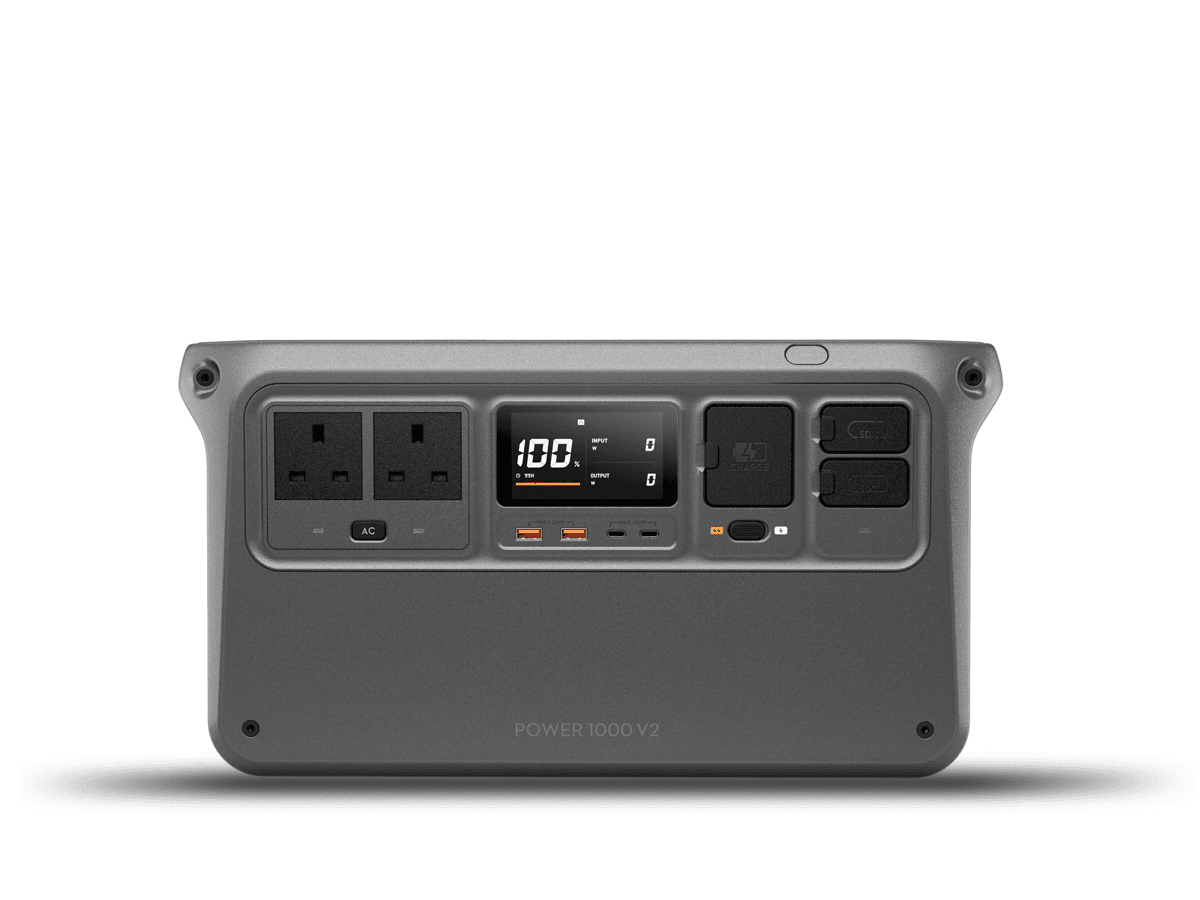 Image © DJI


SMALL · UNDER 1,000 Wh
The lightest and cheapest size. Enough to keep the router on, phones charged and a lantern lit for about a day, or to run a CPAP machine overnight.
Not the right size for keeping a fridge-freezer cold through a long power cut.
WHAT A TYPICAL 512 Wh MODEL WILL RUN
27 hours
Router, phones and lanterns
1 night
CPAP machine
18 hours
Fridge-freezer on its own


Eight things that make the difference between a power station that copes and one that lets you down.
Capacity (Wh)
How much energy it stores. The bigger the number, the longer it runs.
Output (W)
The most it can power at once. Add up the watts of everything you’ll plug in at the same time.
Surge (peak W)
Fridges and freezers need a short burst of extra power when the motor starts. Check the surge figure covers it.
Battery type
LiFePO4 (also called LFP) batteries last for many more charge cycles than older lithium-ion types.
Automatic switchover
Called UPS or EPS. It takes over by itself when the power cuts: useful for a CPAP machine, router or freezer. Check the switchover time.
UK sockets
Make sure the UK version has 3-pin UK sockets, so you don’t need adaptors.
Solar charging
Lets you recharge during a long power cut. Check the maximum solar input in watts.
Weight
The biggest models are very heavy. Check you can move it to where you’ll need it.
SAFETY
Never connect a power station to your home’s wiring yourself. It needs a qualified electrician and the right changeover switch, or it can put you and network engineers at risk.
Plug appliances straight into the power station, or use a good-quality extension lead. Don’t go over its output limit.
Use it on a flat, dry surface with space around it for air. Keep it away from heat and water.
Keep it charged. Follow the manufacturer’s storage advice: most suggest checking and topping up every few months.
Never run a petrol or diesel generator indoors or in a garage. Its fumes contain carbon monoxide, which can kill.
If someone at home relies on medical equipment, sign up to the Priority Services Register with your electricity supplier.
Prices are the price shown on each retailer’s own product page on 13 November 2026, including VAT. Prices change, so please check before you buy.
Specifications come from each manufacturer’s own UK specification page. Where a retailer and a manufacturer disagree, we say so.
We only include models sold and sent from the UK, with UK sockets. Labels such as “Best value” follow fixed rules: best value is the lowest price per kWh in its size.
Some links are affiliate links. If you buy through one we may earn a small commission. It never changes the price you pay or which products we include.